Donald Horne’s Death of the Lucky Country, his attack on the dismissal of the Whitlam government, its title an allusion to Horne’s 1964 bestseller, was the first ever adult non-fiction book I owned. I have a vague memory of pestering my mother to buy it for me, the $1.50 price tag (still on the back of my copy) being beyond my budget at age ten.

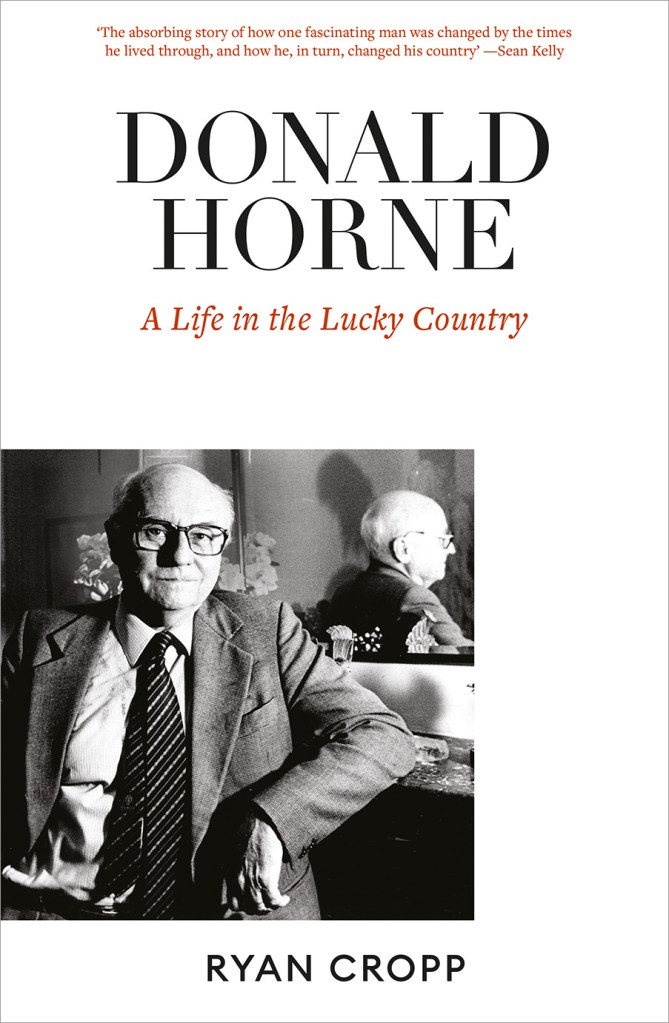
I don’t remember exactly why I wanted Horne’s book; as a very young Liberal I was happy to see the Whitlam government gone. But recently reading Ryan Cropp’s excellent Horne biography, A Life in the Lucky Country, I can see why Horne appealed to my developing interests. He was a ‘public intellectual’ – the quotation marks because this term and perhaps role has faded – someone who bridged the world of ideas and general audiences. Horne’s books — he was as Cropp notes a prolific author – were always easy to read and, thanks to the secondhand bookshops that once existed in large numbers, usually affordable without parental financial assistance.
The causes Horne adopted in the last few decades of his life (he died in 2005), such as opposition to the dismissal and republicanism, sociologically made him left-adjacent in the Australian political context. But as a young man he was more a classical liberal. At the University of Sydney in the early 1940s he fell under the spell of the anti-authoritarian philosopher John Anderson. Horne was a reader of Friedrich Hayek’s The Road to Serfdom, someone who cited Ludwig von Mises (like Hayek an Austrian free market economist, but generally seen as more extreme) in the Daily Telegraph of all of all places.
Horne spent much of his early career in the commercial media, including modernising and reviving The Bulletin, but was also involved in smaller intellectual publications, including editing Quadrant for a while in the 1960s. (I was amused to read that in 1958 Quadrant supporters complained that rival left-wing little magazines such as Meanjin received government arts funding but they did not, a grumble that still appears in Quadrant fundraising.)
Cropp does not see Horne’s changing political positions as a straightforward rejection of his past, more the ‘evolution of a reforming liberalism that he had always espoused’, in the context of a political culture and political parties that were also changing. In my review of the last volume of David Kemp’s liberal political history of Australia, I noted how conservative liberalism lost its way in the 1960s, with Gough Whitlam’s modernisation of the Labor Party making it in some respects more liberal than the party claiming that name.
Cropp does not claim that Horne was an especially original thinker or, after he joined UNSW in the 1970s, a great scholar. But he was ‘interested in anything and everything’ and had a talent for the ‘memorable phrase,’ of which ‘the lucky country’ is the most famous. These phrases can resonate because, as Cropp observes, they capture ideas that are in the zeitgeist but need a writer able to ‘identify, distil, and popularise’. Perhaps it was the memorable title that led me to Death of the Lucky Country in 1976.
This book started life as a PhD thesis, but 50-plus pages of endnotes are the only trace of it. It tells the story of Horne’s life and times without jargon or over-theorising. Perhaps only middle-aged plus readers will feel a connection to the people and events it describes. But anyone with an interest in Sydney’s contribution to the world of Australian ideas from the 1940s to the 1990s will enjoy this biography of one its key figures, whose sociability and love of the long lunch means that many of the people who mattered get at least walk-on parts.

 Andrew Norton