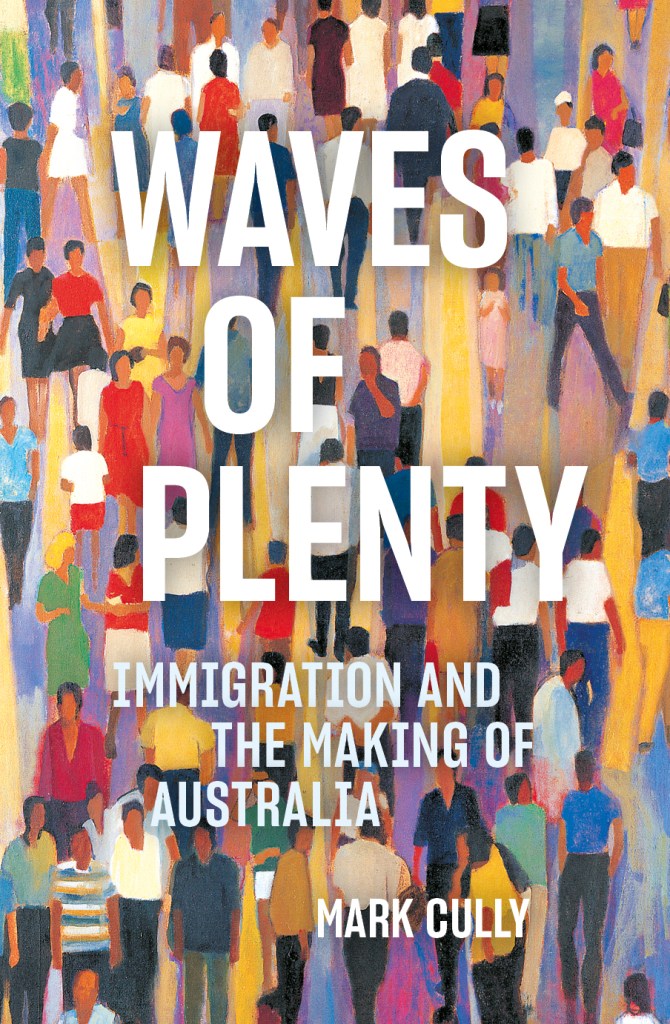
Waves of Plenty: Immigration and the Making of Australia by Mark Cully is, so far as I am aware, the only migration history to cover the subject’s whole history, from the earliest to the latest arrivals on the Australian continent. It discusses in detail six key decades of change. Recurring themes through the historical chapters are treated more analytically in concluding chapters.
The first migrations
The first migration occurs tens of thousands of years ago, when the ancestors of today’s Indigenous or ‘First Nations’ population arrive on the land that became Australia. As Cully notes, over thousands of years they then migrated across the vast continent. Rising sea levels stopped further overseas migration for millennia.
Once long-distance sea travel became possible, no peoples isolated by ocean were entirely safe from unwelcome arrivals (Cully the economist is alert to how technology and cost affect people movement). To the Indigenous peoples the next wave of arrivals, the British from 1788, were invaders. But the British and then the Australians also worried about invasion, from France, Russia, and later Japan. Fear of future invasion contributed to ‘populate or perish’ migration after WW2.
Coercion was central to the early decades of colonisation. The British took Indigenous land and populated it with transported criminals, the convicts, and their guards.
The 1830s — free settlers become a majority
The first post-colonisation decade Cully examines in detail is the 1830s. In this decade free migrants outnumbered convicts for the first time. The cost of travel to Australia exceeded the means of most people in Britain and Ireland, leading to an assisted passage scheme funded by land sales. While the colony remained male dominated, free migration led to a more even gender mix, a prerequisite for a long-term society. A growing population meant turning more land over to farming. Beyond the actions of the British state, ‘squatters’ took land and displaced Indigenous populations. This violence and disease reduced the Indigenous population; the 1830s may have been when they were first outnumbered by post-1788 arrivals and their children.
The next big decade is the 1850s gold rush. Victoria was the centre of it, its population growing from 77,000 in 1851 to 538,000 in 1861. It is the start of migration linked to economic cycles. Migrants could just turn up. My Irish maternal great-great-great grandfather arrived in Melbourne in the early 1860s. Ethnic diversity reached levels not seen again for another century. Of the many nationalities in Victoria, Chinese migrants were the most contentious. A £10 entry tax on Chinese miners, levied by the Victorian government in 1855, started migration policy aimed at keeping people out.
The 1890s and 1900s — migration restricted
The 1890s is Cully’s next big decade, on his list for its political shifts rather than its migrant arrivals. Australia had become rich in the 19th century but economic depression arrived in the 1890s. The rise of trade unions meant more organised resistance to migrants who might lower labour costs. The spread of the male franchise gave popular opinion more influence on policy. The use of South Sea Islanders on Queensland sugar plantations became contentious. The decade finishes with successful 1899 referendums approving federation in five states. WA follows in 1900 and Australia begins on 1 January 1901, although on Cully’s account as a federation but not yet as a nation. Its people were British subjects and not permitted an independent foreign policy.
In Cully’s book federated Australia’s first decade appears in the 1890s chapter, as flowing from its politics and events. For British diplomatic reasons, no outright ban was placed on non-white migrants, but the now-infamous White Australia policy was introduced via a dictation test. This policy was copied from another British colony, Natal in Africa. It required would-be migrants to apply for admission in any European language set by migration officials. On Cully’s figures, in its first decade 59 people passed the test, but none after 1909.
Australia’s first half century was terrible: World War I, the Great Depression, World War II. My paternal grandfather arrived just before these disasters, in 1911, for reasons lost in history but presumably economic. He came from a working class family of 12 children. Four of them migrated, three to Australia and one to Canada. Travel times by the early 20th century from Britain to Australia were 4-6 weeks by steamship, much less than the 3-4 months by sailing ship a century earlier. Cully skips over these years, although the helpful statistics he puts in an appendix show significant net migration in all decades but the 1930s, another case of migration following the economic cycle. These decades are important to many family histories, but not for policy change.
Post-WW2 migration
In the late 1940s Australia was not the land of promise it had been from the 1830s to 1880s. It was badly battered by war and economic depression. As Cully puts it, ‘their outlook could only have been one of gloomy stoicism’. But migration is built on the hope of something better. Australia’s first half of the twentieth century was bad, but Europe’s was worse, much worse. For people in displaced persons camps, or living on tight rations in bombed-out cities, migration seemed like a better option, even to a country like Australia most of them knew little about.
In Australia Labor governments in the 1940s saw the need for a larger population, to meet expected post-war labour shortages and in the belief that Australia’s security required a larger population, ‘populate or perish’ in the famous phrase. Cully emphasises what a shift this was for Labor, which was historically more anti-migration than its main political opponent, the Liberal Party and its predecessor parties.
Government was reorganised to support large-scale migration. In 1945 Labor established an immigration department, which Cully says was the first government department in the world dedicated solely to immigration. This department was also the first in the world to offer systematic and widespread language training. In 1948 Australia passed its first citizenship act.
Labor wanted to keep migration as British as possible but was pragmatic, an approach shared by the Liberal government that took over in 1949. In the 1950s there was unlimited assisted migration from Britain for a heavily subsidised £10 fare, the ‘£10 poms’. By the mid-1950s Australia ran assisted migration programs for people from Austria, Germany, Greece, Ireland, Italy, Denmark, Finland, Norway, Sweden, Switzerland and the United States (growing up in suburban Melbourne in the 1970s our neighbours were Italian on one side, Norwegian/British on the other). It seems remarkable to me that three of Australia’s 1940s wartime enemy nations made the list. But the White Australia policy remained in place, with no programs bringing people from Asian countries.
Cully’s decadal migration flow table reports 865,000 net migration in the 1950s, roughly the same as had arrived cumulatively from the 1890s to the 1940s.
The 1970s
Like the 1890s, the 1970s is in Cully’s book for its politics more than its migrant arrivals. It had the lowest net migration of any decade in the whole period from the 1950s to now.
In Cully’s view, too much is made of the Whitlam government’s removal of the last remnants of the White Australia policy. It was mostly gone already (I recommend Gwenda Tavan’s excellent book on that story, sadly it seems to be out of print). With a reduced migration program, there was less opportunity for people of any background to arrive. In 1975, Whitlam’s last year in office, net migration was just 13,500. I was surprised to learn that assisted migration limped along until as late as 1977, and even more surprised that these last assisted migrants arrived by ship.
While migration numbers were low, the 1970s started a new period of bureaucratic selection of migrants, with a predecessor of today’s points test commencing in 1973. By 1979 prospective migrants had to score at least 60 of a potential 100 points, with at least 30 each from points allocated to economic and personal/settlement factors. The points test favoured applicants with better job prospects, creating tension with existing migrant communities that wanted more places for family reunion. Then as now, there was a contest in national planning levels between skills and family programs.
What triggered the first major flows of migration from Asia wasn’t an officially non-discriminatory migration policy. It was refugees from war and communism in Vietnam, Cambodia and Laos. Taking people displaced by war and communism had a post-WW2 precedent, but Australia chose these migrants in Europe and then transported them to Australia. Some Indochinese refugees, by contrast, self-selected and arrived unannounced by boat. The first group arrived in Darwin in April 1976. Most subsequent Indochinese refugees — over 60,000 by 1981 — were resettled from camps in Malaysia, but the politics of ‘boat people’ have been prominent in Australia since.
Separate from the issue of numbers was the official relationship between migrants and the mostly Anglo-Celtic Australian-born majority (Cully observes that British migrants tend to get lost in the histories of post-WW2 migration, despite until recently being the largest single group not born in Australia). In the post-WW2 period the expectation was assimilation, from the 1970s the official doctrine was ‘multiculturalism’. In practice, it has always been a mix of both.
The 2000s
In the late 1990s and 2000s, the last of Cully’s key decades, Australia starts a series of changes to migration policy that finally became deeply controversial in the mid-2020s. On the surface, many things looked similar to the migration models established in the 1970s. There were ups and downs in the annual number of permanent migrants, usually following the economic cycle. There were tweaks to the skills/family split in the program; the Howard government in the mid-1990s gave a higher priority to skills. But underlying this continuity was growth in long-term temporary migration and a more drawn-out process of becoming a full member of the Australian community.
To my surprise, someone I knew late in her life, the economist Helen Hughes, cops criticism for this, although by the time I knew her in the 2000s she was mostly writing about the continent’s first arrivals, through Indigenous policy. The link is her role in two 1980s government reports.
The first was the Jackson review of overseas aid. Hughes was its deputy chair, according to Cully because foreign minister Bill Hayden liked her when she taught him economics at the University of Queensland in the 1960s. The Jackson report recommended continued education aid (which still exists), but apparently on the influence of Hughes argued that this was consistent with full-fee places for private international students. The Goldring review of overseas student policy, released a few weeks later than Jackson in 1984, recommended against full-fee places. The Hawke government, keen on a potential new export industry, went with the Jackson view.
In the 1990s international student full-fee enrolments had strong growth rates, but off a low base and without strong migration incentives. In the late 1990s the Howard government changed the points test in ways that favoured former international students. In 2001 the requirement for students to leave Australia before applying for permanent residence was abolished. Migration-focused international students quickly took advantage of these rules, driving enrolment surges in course with easy paths to permanent residence. The rules were tightened to bring numbers back under control.
But universities had become addicted to international student fees. Softer migration policy was an easier policy request in Canberra than more public funding. In 2007 the first version of the temporary graduate visa, which gives former students more time to find work that might attract employer sponsorship or additional points for the points-tested visas, was introduced. From 2008 international students no longer needed to apply for work rights, which were automatically granted at 20 hours per week. Working while studying became essential for students from poorer countries to fund their time in Australia.
International students became the largest group of long-term temporary migrants (there are more people from New Zealand; they mostly have limited access to the Australian welfare state, which makes them similar to temporary migrants, but can stay indefinitely, which makes them different). With students from some source countries having high employment rates they became an important ‘guest worker’ group in low-paid occupations. Despite a downward trend, more than 550,000 international students lived in Australia at the end of September 2026.
The Howard government also introduced, on the advice of a report commissioned by the previous Labor government, the subclass 457 temporary work visa, aimed at making it easier for employers to access skills not available in Australia. Its numbers also grew and it became a pathway to permanent residence. A successor visa, the subclass 482 Skills in Demand visa, performs a similar function and is increasingly used by former international students.
The consequence of these and other temporary visas is that many people spend extended periods of time in Australia without the right to stay permanently. Their lack of access to welfare benefits makes them vulnerable. They have often been exploited in labour and housing markets. They have created a guest worker economy, an idea Australia has never officially adopted and clearly rejected until the mid-1990s. Some temporary visa holders eventually achieve permanent residence, which is now often granted to people already onshore.
The other Hughes-influenced committee was the 1988 Fitzgerald review of migration policy. This had already contributed to a shift away from family towards skilled migration. This report included a ‘thought bubble’ of tying public benefits to citizenship. Apart from access to student loans there are, nearly 40 years on from Fitzgerald, no financial benefits I know of available to citizens that are not also available to permanent residents. But a two-year waiting period for some income support benefits was introduced for new permanent residents from 1997. This was extended to four years in 2019. The Liberals plan to restrict 17 benefits to citizens if they win office, so perhaps the thought bubble will eventually become policy.
Policies for the future
It is unfair to say that ‘Helen Hughes has much to answer for’. Her early support for full-fee international students led to our current situation only via many other developments that were impossible to predict in the 1980s. I was not persuaded, although I am happy to see additional evidence, of a direct line between the Fitzgerald report and much later changes to the benefits attached to permanent residence. Governments are always looking for ‘savings’ and have often cut benefit eligibility in the process. People who cannot (yet) vote are a soft target.
But I am convinced that dozens of different decisions since the 1980s, and especially since the mid-1990s, have led to consequences that were not foreseen or wanted. No Cabinet in Australia’s history would have approved a policy to allow 2.5 million long-term temporary migrants to live in Australia. But that is exactly where we have ended up.
Australia’s labour market relies too heavily on temporary migrants to go back to the pre-1990s system. But like Cully I think that their numbers need to be brought down, in their own interests as well as to alleviate pressures on accommodation and services. This is partly about how many people get a temporary visa, partly about how long they stay. Many temporary migrants are young adults spending years of career and family formation time in the often futile hope of permanent residence. Cully’s idea of a fixed maximum time on temporary visas makes sense in this context. If PR is not achieved by a certain time it is best to cut losses and return home.
Whether or not Helen Hughes should share any blame for creating multiple classes of permanent residence, Australian policymakers have sufficiently though through the rights and duties associated with migration status. The social security system is a form of insurance, with taxes paid in return for financial protection if needed. Residence requirements are not unusual, to ensure that most people who take money out of the insurance pool also contribute to it. Australian citizens generally cannot receive the age pension unless they have resided in Australia for at least a decade. Generally Australian benefits won’t be paid to Australian citizens living overseas. But the new way of getting permanent residence, often after first working for years on temporary visas while paying income tax, makes current delays to social security rights less defensible than when PR was usually granted prior to arrival.
Despite a few minor disagreements with Waves of Plenty it is overall an excellent book, both educational and enjoyable.


